Le Corbusier Chandigarh Highlights Tour
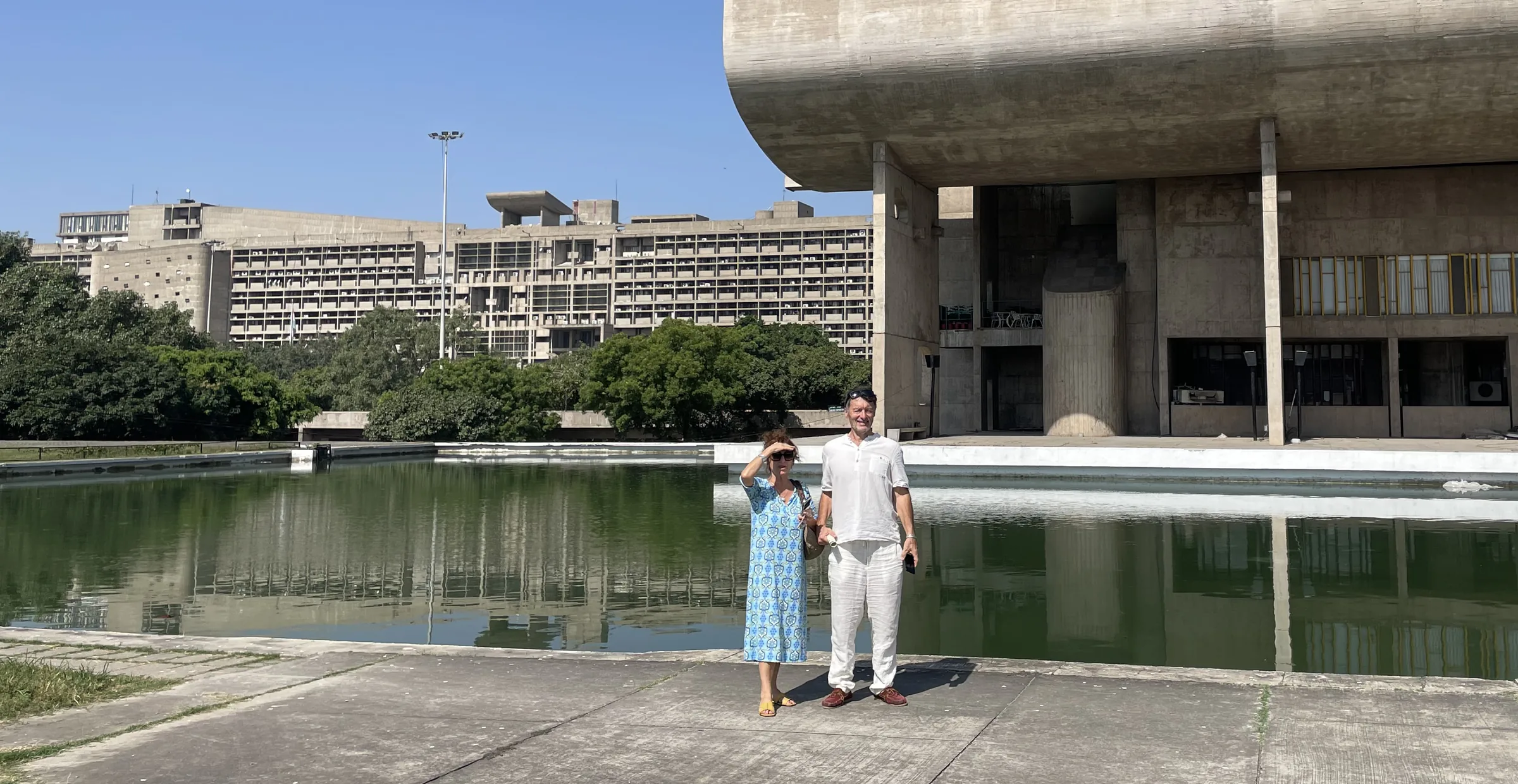
A one-day, 6-hour guided tour of Le Corbusier’s Chandigarh, with insider access to the Capitol Complex. Maximum 8 people, from €68 per person, with pickup, tickets and photography permits included. Full tour details
- Duration
- One day · 6 hours
- Group size
- Max 8 people
- Best days
- Tuesday – Friday
- Transport
- Pickup & drop included
- From
- €68 per person
Chandigarh Travel FAQ
Everything visitors ask about the Capitol Complex, Le Corbusier’s city, where to stay and how to get around, answered by your local guide, Rusty. Pick a guide to see its questions, or browse them all below. Can’t find yours? Email Rusty; he replies within minutes.
Chandigarh guides by topic
 How to visit the Capitol Complex in Chandigarh
 Le Corbusier's buildings in Chandigarh: every one, and which you can enter
 Chandigarh architecture tour: with a guide or on your own
- Chandigarh in one day: an architecture itinerary
 Two days in Chandigarh: a plan from a local
 Is Chandigarh worth visiting? Who will like it and who should skip it
 Best time to visit Chandigarh, month by month
 Capitol Complex timings, tickets and closed days
 Pierre Jeanneret in Chandigarh: his house, the museum, housing and furniture
- Who designed Chandigarh: Le Corbusier, Pierre Jeanneret and the team
- Delhi to Chandigarh: train, Vande Bharat, bus, taxi or flight
- Chandigarh and UNESCO: what is listed and what is not
 Where to stay in Chandigarh
- Is Chandigarh safe? Tourists, solo women and families
- The Palace of Assembly: what it is and whether you can go inside
- The Open Hand Monument: what it means and how to see it
- The Secretariat and the Tower of Shadows
- The High Court (Palace of Justice): what to know before you go
- The Geometric Hill and the Martyrs Memorial
- The Le Corbusier Centre: timings, what is inside and the cafe
 Pierre Jeanneret chairs: history, originals, copies and prices
- Gandhi Bhawan at Panjab University: architect, timings and how to visit
- Chandigarh's master plan: sectors, the grid and the road hierarchy
 Museums in Chandigarh: which ones to visit
- The Rock Garden: timings, tickets and how long to give it
- Sukhna Lake and the Rose Garden: when to go
- Sector 17 Plaza and the city centre
- Three days in Chandigarh
- Chandigarh with kids and family
- Chandigarh in the evening and at night
- Chandigarh and Shimla together: a two or three day plan
- Chandigarh and Amritsar together
- Chandigarh weather by month, and what to pack
- Tickets, permits and ID: what you need for each building
- Photography at Le Corbusier’s buildings: rules and tips
- How to reach Chandigarh: air, train, bus and road
- Getting around Chandigarh: cabs, autos, buses and walking
- Chandigarh food: what to eat and where
- The Chandigarh city tour bus, compared with a private guide
- Chandigarh architecture explained: beton brut, brise-soleil and other terms
- Why Chandigarh is called the City Beautiful
- Chandigarh, Punjab and Haryana: how one city is a capital for two states
- Chandigarh compared with other planned cities: Brasília, Canberra, Bhubaneswar
- Heritage walks and heritage sites in Chandigarh
- Day trips from Chandigarh: Kasauli, Shimla, Pinjore and more
- Chandigarh for architecture students: what to see, sketch and measure
- Chandigarh or Delhi, Jaipur, Shimla: how to choose
- Chandigarh for visitors from abroad: visa, money, SIM cards and tipping
- Chandigarh with reduced mobility
- Chandigarh airport (IXC) to the city
- Shopping in Chandigarh: markets and what to buy
Chandigarh questions and answers
Yes. Every visit to the Capitol Complex in Chandigarh needs prior permission and registration. You cannot walk in on your own, not even for ten minutes to admire the architecture or take photos. The Capitol Complex is a working, high-security government area, so the only way in is on the official guided tour. Register at the Capitol Complex reception in Sector 1 at least 15 minutes before the tour starts, and carry a photo ID (foreign visitors need their passport). Or skip the paperwork: on a Hipster India Tours architecture tour, we handle the registration for you.
You book the Capitol Complex tour in person on the day. Go to the reception at the Capitol Complex in Sector 1 at least 15 minutes before one of the three daily tours (10am, 12pm and 3pm), show your photo ID or passport and register. The tour is free. If you would rather skip the queue and see the Capitol Complex as part of a full day of Le Corbusier's architecture, our one-day Chandigarh architecture tour handles registration, transport and parking for you.
Yes. Entry to the Capitol Complex is free, but you must register for one of the government guided tours, which run daily at 10am, 12pm and 3pm. If you would like to explore the Capitol Complex with a private guide, along with the rest of Chandigarh's architecture, you can book a Hipster India Tours architecture tour here.
The Capitol Complex is open from 10am to 5pm, but you can only enter on one of the three guided tours, at 10am, 12pm and 3pm. Arrive 15 minutes early to register with your ID. From Monday to Friday the tour includes the inside of the Palace of Assembly; on Saturday and Sunday it is outside only. It is closed on gazetted holidays.
The Capitol Complex is open on weekends, but the weekend tour is shorter and does not go inside the Palace of Assembly (Vidhan Sabha). We recommend a weekday visit if you can manage it, though the weekend tour is still worth doing. The Capitol Complex is always closed on public holidays.
The Capitol Complex is in Sector 1, at the northern head of Chandigarh's grid, with the Shivalik hills behind it. Le Corbusier placed it there on purpose: in his master plan the government sits at the "head" of the city, looking down over the sectors. It is about 4 km from Sector 17 and close to Sukhna Lake and the Rock Garden, so all three are easy to combine in a day.
Take a taxi, Uber or auto-rickshaw to the Capitol Complex in Sector 1. Parking is very limited and almost always full, so plan for that if you are driving yourself. On a Hipster India Tours day, pickup, drop-off, parking and transport between every site are already included, so you don't need to think about getting there at all.
The official Capitol Complex guided tour usually takes about an hour, plus the 15 minutes you need to arrive early to register. On weekdays the tour goes inside the Palace of Assembly; on weekends it is a shorter outside-only walk. On our architecture tour we spend longer at each building, because the Capitol Complex is the centrepiece of Le Corbusier's Chandigarh and deserves the time.
No. Nobody can visit the Capitol Complex without a guide and security staff. It is a sensitive government area that houses the Punjab and Haryana High Court, the Legislative Assemblies of Punjab and Haryana, and the Secretariat for both states. You can only enter as part of an organised, time-limited group tour.
Visit the Capitol Complex on a weekday, Tuesday to Friday if you can. From Monday to Friday the guided tour goes inside the Palace of Assembly; on Saturdays and Sundays you only see the buildings from outside. Tuesday to Friday also works best for the rest of Chandigarh, because most museums, including the Le Corbusier Centre and the Pierre Jeanneret Museum, are closed on Mondays. The Capitol Complex is closed on gazetted (public) holidays.
Yes. The Capitol Complex has been a UNESCO World Heritage Site since 2016. It is one of 17 sites in seven countries listed together as "The Architectural Work of Le Corbusier", and the only one in India. It is also the biggest built project of his career.
On your own, you can go inside the Palace of Assembly (weekday Capitol Complex tours only), the Government Museum and Art Gallery in Sector 10 and the Le Corbusier Centre in Sector 19, his old site office. The Secretariat is closed to visitors, and the High Court is a working court. With Hipster India Tours you also get guided access to buildings that are usually closed to the public.
Le Corbusier was the chief architect of Chandigarh and drew its master plan. His buildings in Chandigarh include the Palace of Justice (Punjab and Haryana High Court), the Palace of Assembly (Vidhan Sabha), the Secretariat, the Open Hand Monument, the Tower of Shadows, the Martyrs' Memorial, the Government Museum and Art Gallery, and the Sector 17 city centre plan, along with contributions to several other buildings. You can see them all on our two-day Chandigarh architecture tour.
Pierre Jeanneret (1896–1967) was a Swiss architect and furniture designer, and Le Corbusier's cousin and long-time partner. In Chandigarh he was the chief architect on site, living in the city from 1951 to 1965 while Le Corbusier visited only for short spells. He designed much of everyday Chandigarh: government housing, schools, Panjab University's Gandhi Bhawan and library, and the famous Chandigarh chairs. His ashes were scattered in Sukhna Lake, as he wished.
The Pierre Jeanneret Museum is at 57 Uttar Marg in Sector 5, near Sukhna Lake. It is the house where Jeanneret lived from 1954 to 1965, restored and opened as a museum in 2017. It is open 10am to 5pm, Tuesday to Sunday, and closed on Mondays and public holidays. Entry is free. Inside are his drawings, letters, furniture and personal belongings.
Yes. Pierre Jeanneret's house in Sector 5, often called "the first house of Chandigarh", is now the Pierre Jeanneret Museum and open to the public from Tuesday to Sunday. With Hipster India Tours you see it with a guide who knows its stories: the original woodwork, built-in shelves, curves, stonework and many small details from his design, and the bedroom where Le Corbusier stayed when he was in the city.
Chandigarh was designed by Le Corbusier, the Swiss-French architect, working with Pierre Jeanneret, Maxwell Fry, Jane Drew and a team of young Indian architects and engineers. The first plan was drawn by American planner Albert Mayer and Polish architect Matthew Nowicki. After Nowicki died in a plane crash in 1950, Le Corbusier took over and reshaped the plan into the grid of sectors you see today.
The Capitol Complex in Chandigarh was designed by the Swiss-French architect Le Corbusier and his team. It is the largest built project of his career and a UNESCO World Heritage Site.
Chandigarh was planned between 1949 and 1951 and built through the 1950s and 1960s. Le Corbusier took over the master plan in 1951, the first buildings went up soon after, and the city was formally inaugurated on 7 October 1953. Work on the Capitol Complex continued into the 1960s, and the Open Hand Monument was only completed in 1985, long after his death.
When India became independent in 1947, Punjab was divided between India and Pakistan, and its capital, Lahore, went to Pakistan. Indian Punjab needed a new capital, so the government decided to build one from scratch. That is how Chandigarh began.
Not the whole city. Only the Capitol Complex in Sector 1 is a UNESCO World Heritage Site, listed in 2016 as part of "The Architectural Work of Le Corbusier". The rest of Chandigarh, including the sectors, Sukhna Lake and the buildings by Pierre Jeanneret, is protected by local heritage rules but is not on the UNESCO list.
The UNESCO listing covers the Capitol Complex in Chandigarh, which includes the Palace of Assembly (Vidhan Sabha), the Palace of Justice (Punjab and Haryana High Court), the Secretariat, the Open Hand Monument, the Tower of Shadows, the Geometric Hill and the Martyrs' Memorial.
The best places to visit in Chandigarh are the Capitol Complex (a UNESCO World Heritage Site), the Rock Garden, Sukhna Lake, the Sector 17 plaza, the Pierre Jeanneret Museum, the Le Corbusier Centre, the Government Museum and Art Gallery, and the Panjab University campus with Gandhi Bhawan. If you like architecture, the city itself is the attraction: whole neighbourhoods of 1950s modernist housing still in daily use.
Chandigarh is best known for Le Corbusier's Brutalist architecture and its planned layout, but it has many sights that need time to enjoy. In one day, see the Capitol Complex (a UNESCO World Heritage Site), the art at the Rock Garden, Sukhna Lake in the evening and a walk around the Sector 17 plaza. If you love architecture, add a museum or two, such as the Le Corbusier Centre, the Government Museum and Art Gallery or the Pierre Jeanneret Museum. Our one-day Chandigarh highlights tour fits the key architecture sights into six hours.
You can see Chandigarh's highlights in one day if you plan well. A good one-day Chandigarh itinerary is the Capitol Complex tour in the morning, Panjab University and the Le Corbusier Centre around midday, the Rock Garden in the afternoon and Sukhna Lake at sunset. Book the Capitol Complex for 10am, start on a weekday and use a car between sights. Two days is better if you want the museums and Pierre Jeanneret's buildings too.
If you are short on time, skip the Indian Air Force Heritage Museum, the National Gallery of Portraits, the International Dolls Museum, the High Court Museum and the Rose Garden. They are nicely kept but small, and only worth it if you have plenty of time. The city has far better sights to fill a short visit.
Day one: Le Corbusier. Start with the Capitol Complex tour, then Panjab University (Gandhi Bhawan, the Student Centre and the AC Joshi Library), the Pierre Jeanneret Museum, the Le Corbusier Centre and the Architecture Museum. Day two: Pierre Jeanneret and everyday Chandigarh. See the government housing he designed, the Sector 17 plaza, the Government Museum and Art Gallery, the Rock Garden and Sukhna Lake at sunset. This is exactly the route of our two-day Chandigarh architecture tour.
Ideally, two days. That gives you time to enjoy Chandigarh's architecture, heritage and culture properly without feeling rushed. One day is enough for the highlights; three days lets you add a day trip or a slower look at the museums.
Yes, it works by train. The Vande Bharat leaves New Delhi at 5:50am and reaches Chandigarh at about 8:40am, which gets you to the 10am Capitol Complex tour in good time. An evening Shatabdi brings you back to Delhi the same night. It is a long day, though. If you can, stay one night and see Chandigarh properly over two days.
Yes. Chandigarh is a real hidden gem. It shows a contemporary, modernist India that breaks the mould of what most people expect India to be. There is no performative tradition here; the city is calm, quiet and orderly, words not often used about India. It is a leafy, slow-paced city with a balance of peace, heritage and modern comforts.
Yes, if you want a calm break from India's bigger, louder cities. Chandigarh is green, clean and easy to walk, with Sukhna Lake, the Rock Garden, the Rose Garden, good cafes and a relaxed food and nightlife scene. It is also a handy base for Shimla, Kasauli and Amritsar. But if you are after palaces, bazaars and centuries-old monuments, Delhi, Jaipur or Amritsar will suit you better.
The best time to visit Chandigarh is from October to March, with autumn and spring the most pleasant. The monsoon (July and August) often floods roads and causes traffic delays and diversions. Summers can reach 44°C (112°F), which makes sightseeing hard work. The ideal months are October to December and February to March.
The best months to visit Chandigarh are October, November, February and March. Days are warm and sunny (about 20 to 30°C), nights are cool and the city's gardens are at their best. December and January are lovely in the afternoons but can be cold and foggy in the mornings. Avoid May and June, when the heat often goes above 40°C.
Yes. Chandigarh is one of the safest cities in India. A high standard of living, an alert police force, orderly traffic, open public spaces and a smaller population make it a safe, relaxed city to travel in.
Yes. Chandigarh is one of the safest cities in India for solo female travellers. The streets are wide and well lit, the police are visible and the city is calm and orderly. Most of our own guests are solo women travellers. Use normal care: take Uber rather than unmarked taxis at night, and stay in the central sectors rather than the outskirts.
Chandigarh is one of the safest cities in India for women at night. The police are vigilant, there are CCTV cameras at most junctions, and the population is largely educated, so the city is easy to explore after dark. Use the usual care when choosing your company, the areas you visit and how you travel.
Yes. Chandigarh is one of the more relaxed and liberal cities in India, and couples are a normal sight at Sukhna Lake, in cafes and in Sector 17. There is no law in India against unmarried adult couples sharing a hotel room; most hotels only ask for valid photo ID from both guests. A few budget hotels refuse local couples, so check the hotel's policy when you book.
Yes. Chandigarh is very safe and welcoming for Muslim travellers. The city is visibly secular, and people don't concern themselves with anyone's religion. You can dress as religiously as you like.
Yes. Chandigarh is one of the best cities in India to visit with children. Traffic is calmer than in other big cities, there are parks in every sector, and places like the Rock Garden and Sukhna Lake are safe and open. Our tours suit families too: Rusty explains architecture and history in a way children enjoy.
You don't strictly need one, but a guide makes Chandigarh far more rewarding. The city's best sights only make sense with context: the background stories, the architects' ideas and how people actually live in the buildings today. A trained local guide also plans the route, handles permits and gets you into places you would otherwise walk past. That is exactly what a Chandigarh tour guide from Hipster India Tours does.
Our Chandigarh architecture tours start at around €60 per person for a full day of six hours. Both the one-day Le Corbusier Chandigarh highlights tour and the two-day Chandigarh architecture tour include pickup and drop-off, an air-conditioned car, parking, every entry ticket, photography permits and bottled water. Only meals and tips are extra. Prices are shown in your local currency on the booking page.
Yes. Hipster India Tours is run by Rusty, a third-generation Chandigarh resident with a master's degree in communications and 11 years as a journalist. He takes you through Le Corbusier's buildings in Chandigarh with rare insider access. The two-day tour covers the work of Le Corbusier, Pierre Jeanneret, Jane Drew, Maxwell Fry and the Indian architects who shaped the city's history and heritage.
The easiest way from Delhi to Chandigarh is by train: the Vande Bharat and Shatabdi trains take about three hours and run several times a day. You can also drive or take a bus (about 250 km, 4.5 to 5 hours on the NH44), or fly in about an hour to Chandigarh airport. For most travellers the train is the quickest and most comfortable option.
Yes. Two Vande Bharat Express trains run daily from Delhi to Chandigarh: one leaves New Delhi early in the morning (around 5:50am) and one leaves Delhi Cantonment around midday. The journey takes about three hours. The Vande Bharat is fast, comfortable and air-conditioned. Check the Indian Railways (IRCTC) website for the latest times before booking.
Delhi to Chandigarh is about 250 km by road and usually takes four and a half to five hours on the NH44 highway, longer if you leave Delhi during rush hour. The road is a good, wide expressway with plenty of dhabas (roadside eateries) along the way, including the famous ones at Murthal for parathas.
The train from Delhi to Chandigarh is the cheapest, most punctual and most comfortable option. The Vande Bharat and Shatabdi trains are the best on this route, with five departures a day between them. Both serve hot meals at your seat and have clean washrooms, charging points, air conditioning and comfortable seats, and they are rarely late. Highly recommended. Air-conditioned Volvo buses from Delhi's Kashmere Gate ISBT take about five hours, and a Delhi to Chandigarh flight takes about an hour, but the airport travel and security time make it no faster than the train.
Stay in the central or northern sectors of Chandigarh, roughly Sectors 7 to 11 and 15 to 18. They put you close to the Capitol Complex, Sukhna Lake, the Rock Garden and the Sector 17 plaza, and they are the greenest, quietest parts of the city. Avoid the Industrial Area, Zirakpur and Burail unless you need to be near the airport; getting around from there takes much longer.
If your budget allows, stay at the Hyatt Centric, the Taj or the JW Marriott. They are centrally located in safe, convenient neighbourhoods. For a cheaper option, the family-run Jullundur Hotel in Sector 22 (open 7am to 11pm) is right in the heart of the city. Avoid hotels in the Industrial Area, Zirakpur or Burail; they are on the outskirts and make getting around harder.
Chandigarh airport is in Mohali, about 12 to 15 km from the city centre. If you have a very early or late flight, the hotels in Zirakpur and Mohali's Aerocity area are the closest. For a longer stay, choose a central sector instead; the airport is only 30 to 40 minutes away by Uber, and you will be much closer to everything you came to see.
The northern sectors are the best area to stay in Chandigarh for a first-time visitor. They were part of Le Corbusier and Pierre Jeanneret's original master plan and still have heritage homes, very clean roads, little honking, dedicated cycle tracks and wide footpaths. Sectors 7 to 11 and 15 to 18 put you close to the main sights.
Chandigarh is only about 70 years old, so it has no palace or haveli hotels like Rajasthan. What it does have are a few older, family-run hotels and guesthouses from the city's early decades, and modern hotels in heritage sectors. For a true heritage stay, many travellers combine Chandigarh with Amritsar or Shimla, where colonial-era and haveli hotels are common.
Yes. Anyone can visit the Capitol Complex, including foreign tourists, but you must register for the government guided tour on the day. Tours run three times a day, at 10am, 12pm and 3pm. Foreign visitors must bring their passport and arrive 15 minutes early to register. Nobody is allowed in outside the official tour.
As far as we know, you can only register on the day, in person, at the Capitol Complex reception in Sector 1, at least 15 minutes before your tour. Bring your passport or another photo ID. Tours are at 10am, 12pm and 3pm and are free. On a Hipster India Tours day we take care of this for you.
Yes. You can go inside the Palace of Assembly on the official government tour, but only from Monday to Friday. Tours are short and run three times a day, at 10am, 12pm and 3pm; arrive 15 minutes early to register. Nobody is allowed in outside these times. Photography and video are strictly banned inside, as it is a working government building.
The Punjab and Haryana High Court is a working court, so tourists usually see it from outside on the Capitol Complex tour. You can admire its huge sheltering roof, the brightly painted entrance pillars and the ramps from close up. Going inside the courtrooms needs a valid reason and a pass from the court.
Usually not. The Secretariat is a working government building for the states of Punjab and Haryana, with heavy police and security presence, and entry is generally prohibited; even getting close enough to take photos is often not allowed. On some Hipster India Tours days, when conditions allow, we can arrange rare access to the Secretariat roof, with views over the whole Capitol Complex and the city. Contact us to ask about your date.
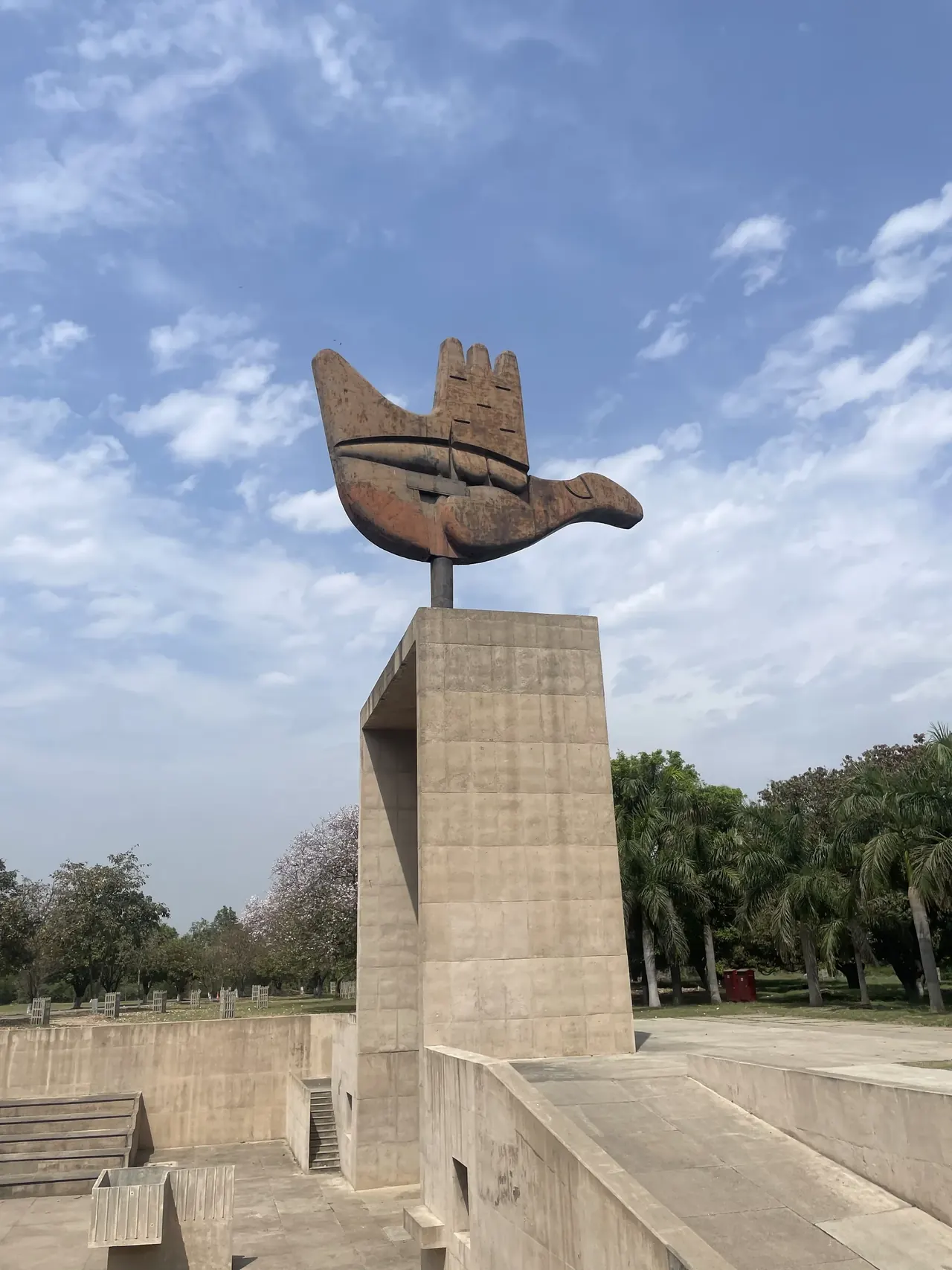
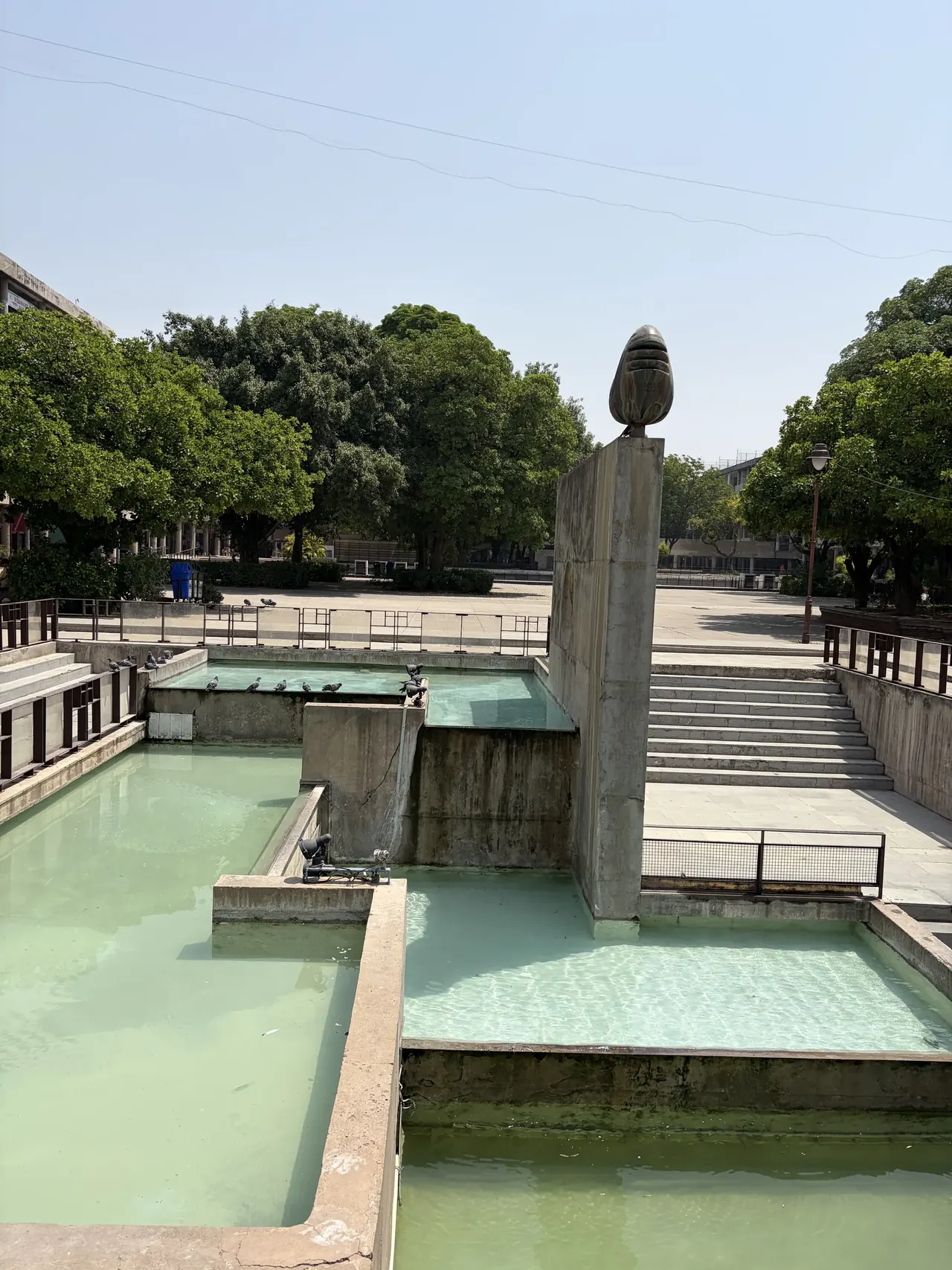
The Open Hand Monument is Chandigarh's official emblem: a 26-metre-high metal hand that turns in the wind, standing in the Capitol Complex. Le Corbusier meant it as a symbol of peace and reconciliation, "open to give, open to receive". It was completed in 1985, nearly 20 years after his death. Below it is a sunken amphitheatre, the "Trench of Consideration", meant for public debate.
Yes. You can walk right up to the Open Hand Monument, and there is no entry fee: it is part of the free Capitol Complex tour, which runs at 10am, 12pm and 3pm. Bring your passport and arrive 15 minutes early to register at the Capitol Complex reception. Nobody can visit the Open Hand outside the official tour, because the whole Capitol Complex is a working government area under strict security. Please follow your guide's instructions.
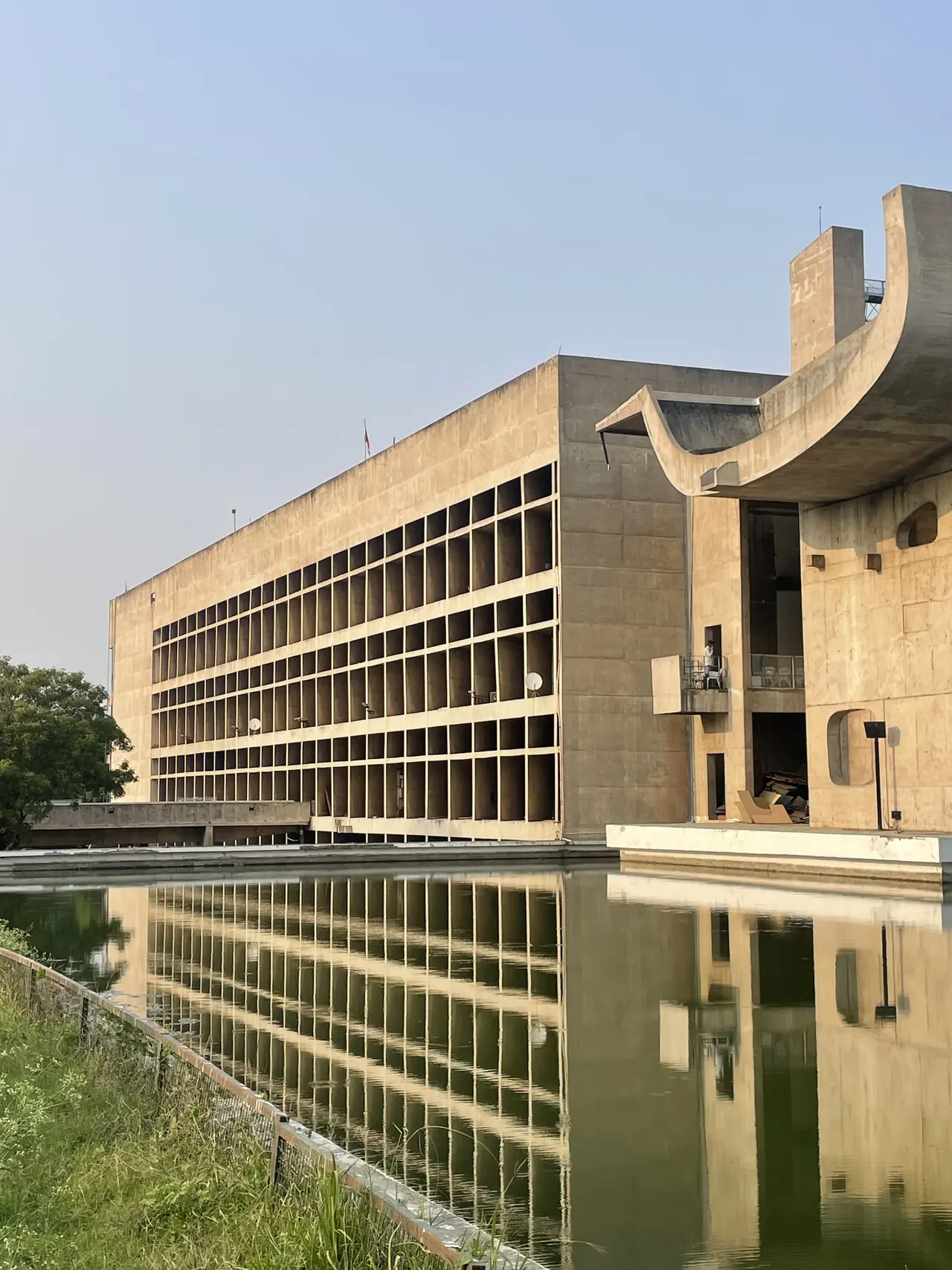
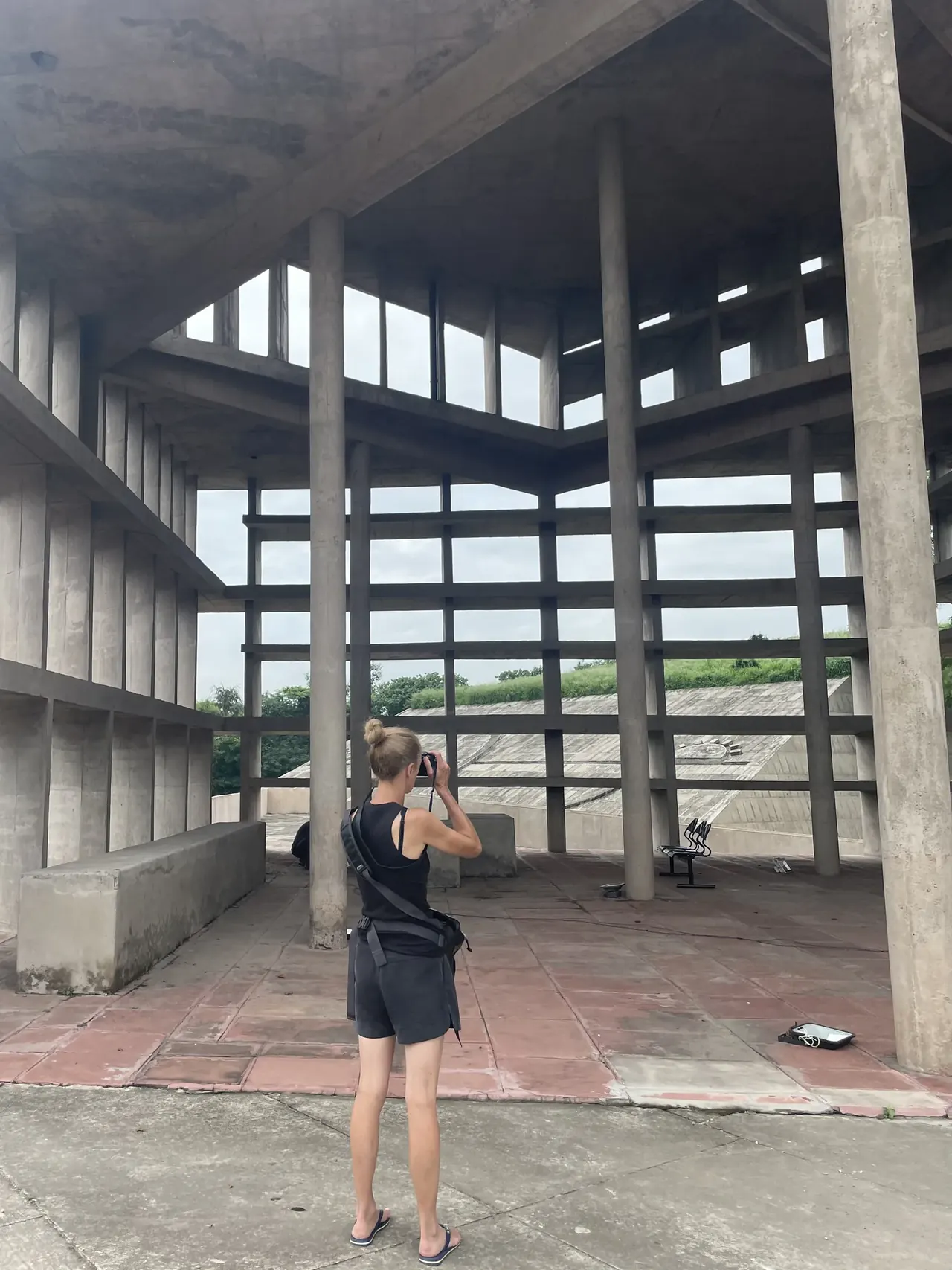
The Tower of Shadows is an open concrete structure in the Capitol Complex that Le Corbusier built to study and show how to control sunlight. Its walls of brise-soleil (sun breakers) are angled for each direction so that direct sun never falls inside, yet light and air pass through. It is a demonstration of the sun-shading ideas he used across all of Chandigarh's buildings.
The Geometric Hill is a large, dome-like artificial hill inside the Capitol Complex, built from leftover construction rubble. It adds texture, depth and visual interest to the open plaza, and its surface is carved with symbols of the sun's daily path. Some say it was meant to screen the government buildings for privacy and security, but Le Corbusier's own purpose was visual: it completes his design of the Capitol.
Photography is allowed outdoors on the Capitol Complex tour, but only where your guide allows it, and it is strictly banned inside the Palace of Assembly. You cannot photograph the Secretariat up close, and drones and tripods are not allowed. Phone and small camera photos of the Open Hand, the Tower of Shadows and the High Court from the plaza are fine.
No. Drones, tripods and large bags are not allowed at the Capitol Complex. You will be searched at security and will not be allowed to take them in, as the whole campus is a working, high-security government area.
There is no formal dress code for the Capitol Complex, but it is a working government area, so modest, comfortable clothes are best. Wear good walking shoes, as the site is large and mostly open concrete plazas with little shade. Bring a hat, sunglasses and water in summer, and a warm layer for winter mornings.
Yes. Original Pierre Jeanneret chairs are extremely valuable to collectors, art historians, museums and design lovers. Some sell for US$15,000 to $20,000 or more at auction. But these chairs are government property, and taking them out of Chandigarh illegally is a criminal offence.
Original Pierre Jeanneret chairs from Chandigarh are made of solid teak or Indian rosewood with hand-woven cane, and many carry painted inventory numbers or letters from the government office or university that owned them. They show decades of wear, old repairs and a deep patina. Copies tend to use lighter wood, machine-made cane and perfect finishes. Even so, telling them apart takes an expert, and any original on sale is very likely to have left Chandigarh illegally.
You cannot buy original Pierre Jeanneret furniture in Chandigarh. It belongs to the city as part of its heritage. Any person, website or contact selling it puts both themselves and you at risk of criminal charges. If you would like a replica made in Chandigarh by local craftspeople, in the same wood and style, we can arrange it. Please contact Hipster India Tours for details.
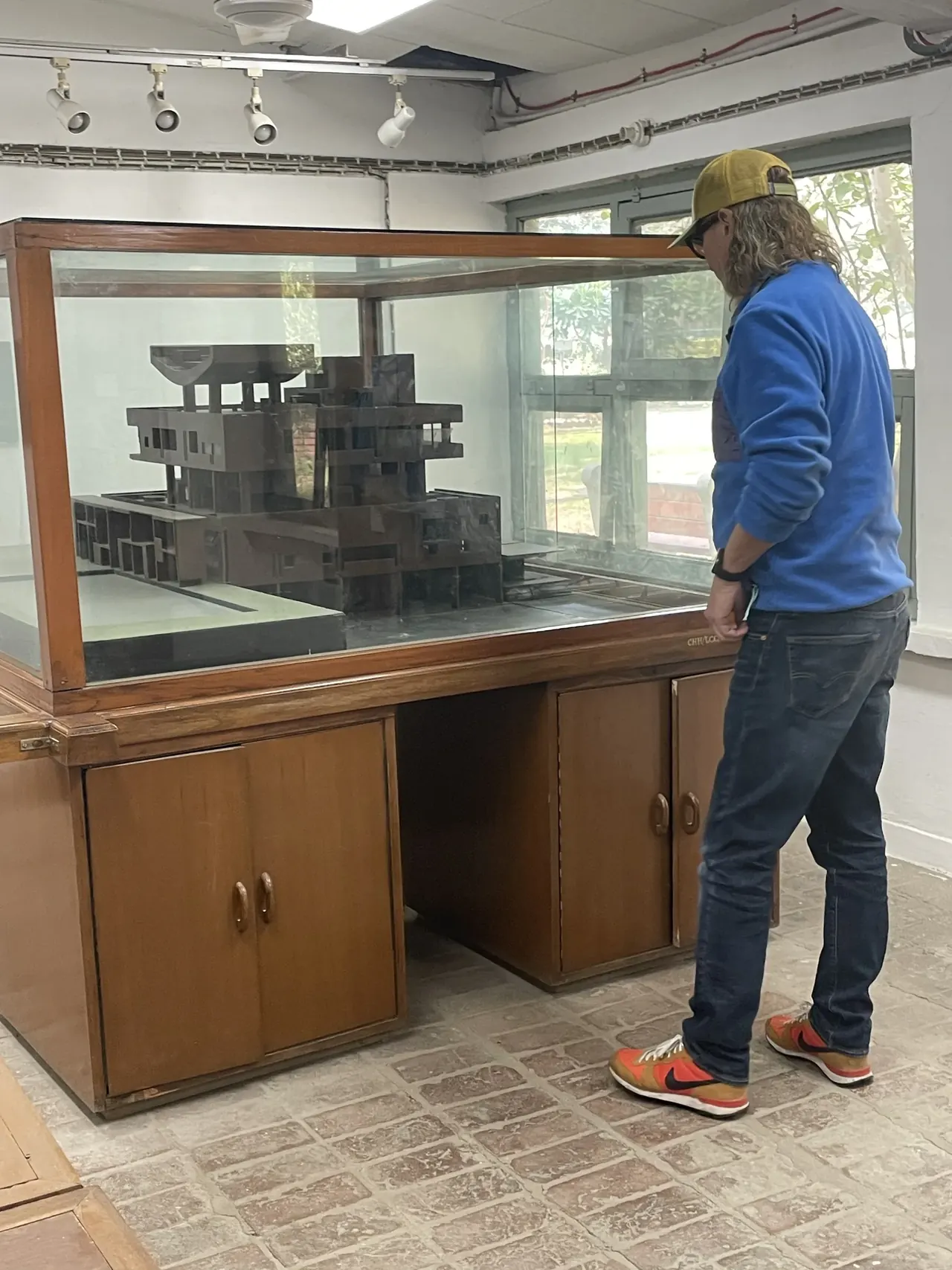
The Le Corbusier Centre in Sector 19 is the old site office where Le Corbusier, Pierre Jeanneret and their team designed Chandigarh in the 1950s. It is one of the first buildings in the city and is now a museum with his original sketches, drawings, letters, photographs, models and furniture. It is the best place to understand how the city was planned.
The Le Corbusier Centre in Sector 19 is open from 10am to 5pm, Tuesday to Sunday. It is closed on Mondays and gazetted holidays. Entry costs ₹20 for adults, plus ₹50 for a camera; children under 18 go free.
Yes, the Le Corbusier Centre in Chandigarh is well worth visiting. It is one of the first buildings in Chandigarh and was the old architects' office. Today it is a museum with a small government-approved souvenir shop. Inside are original drawings, sketches, photographs and other material showing Chandigarh from Le Corbusier's point of view.
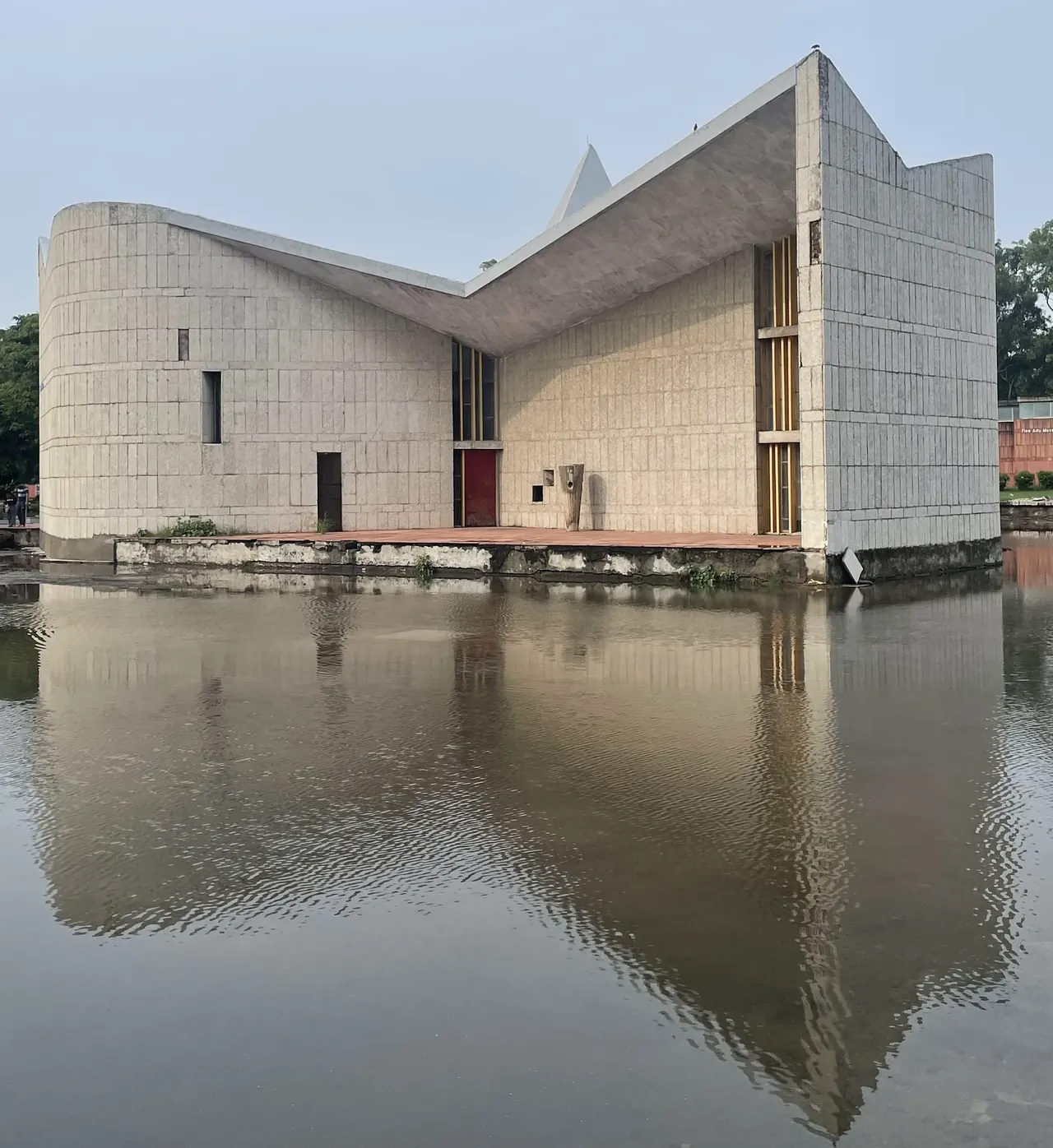
Gandhi Bhawan at Panjab University was designed by Pierre Jeanneret and completed in the early 1960s. Its lotus-like form rises out of a reflecting pool, and the building stays naturally cool without air conditioning. It is one of his finest works in Chandigarh and a favourite of architects and photographers.
Gandhi Bhawan at Panjab University is open from 9:30am to 4pm, Monday to Friday. It is closed on weekends and national holidays.
Yes. Panjab University's campus in Sector 14 is open to visitors, and you can see Gandhi Bhawan and its reflecting pool from outside at any reasonable hour. Going inside depends on the university's timings and on whether events are on. On our tour, we take you inside with the right permissions.
All of Chandigarh is a dream for photographers, thanks to Le Corbusier's Brutalist architecture. The highlights are the Capitol Complex (the Palace of Justice, the Tower of Shadows, the Open Hand, the Geometric Hill, the Secretariat and the Palace of Assembly) and Gandhi Bhawan, as well as the Student Centre, the Architecture Museum and the Government Museum and Art Gallery.
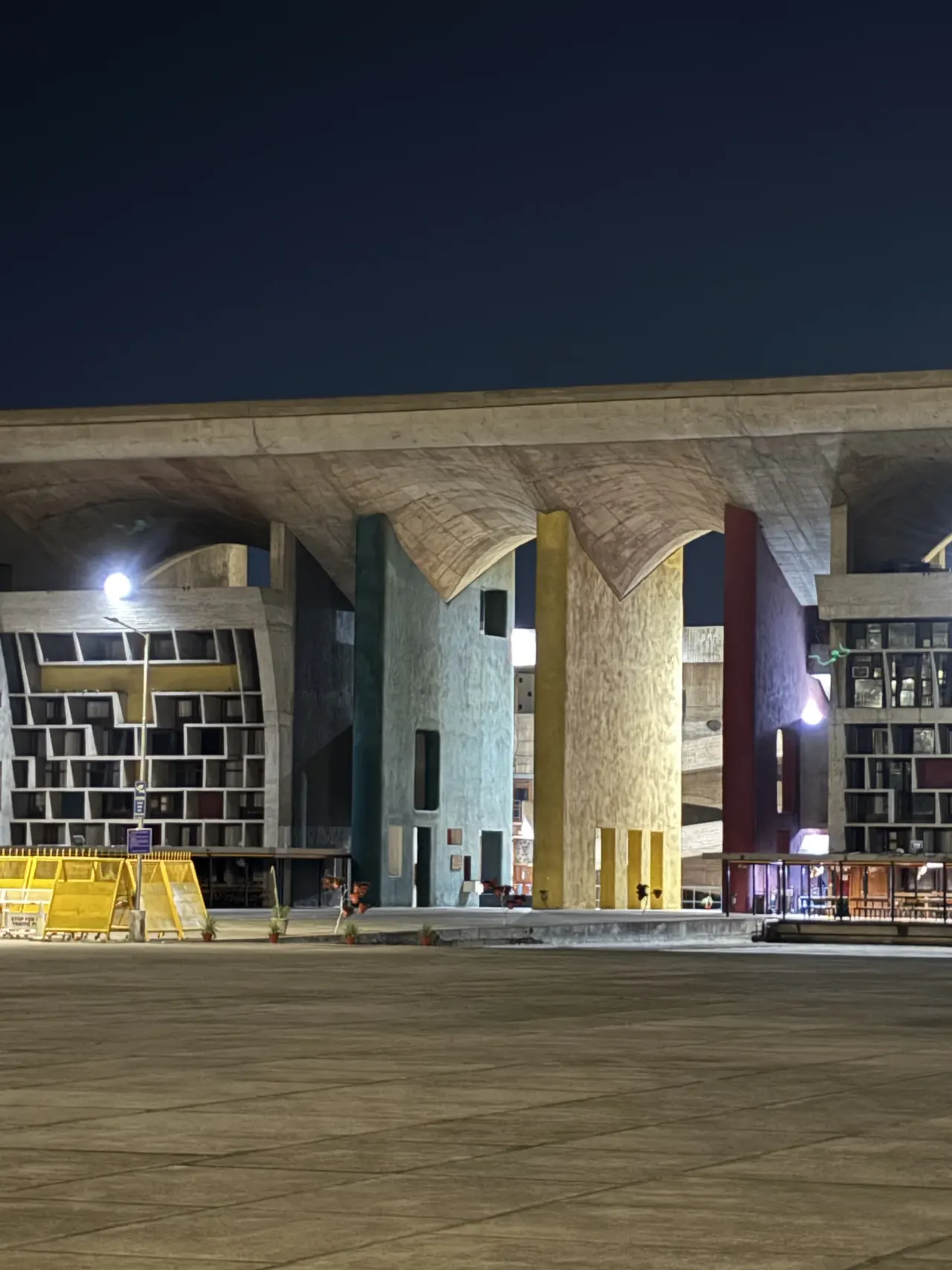
The Punjab and Haryana High Court, also called the Palace of Justice, was designed by Le Corbusier and completed in 1955. It was the first building finished in the Capitol Complex. Its giant concrete umbrella roof shades the courtrooms and lets air flow through, and the three tall pillars at the entrance are painted green, yellow and red.
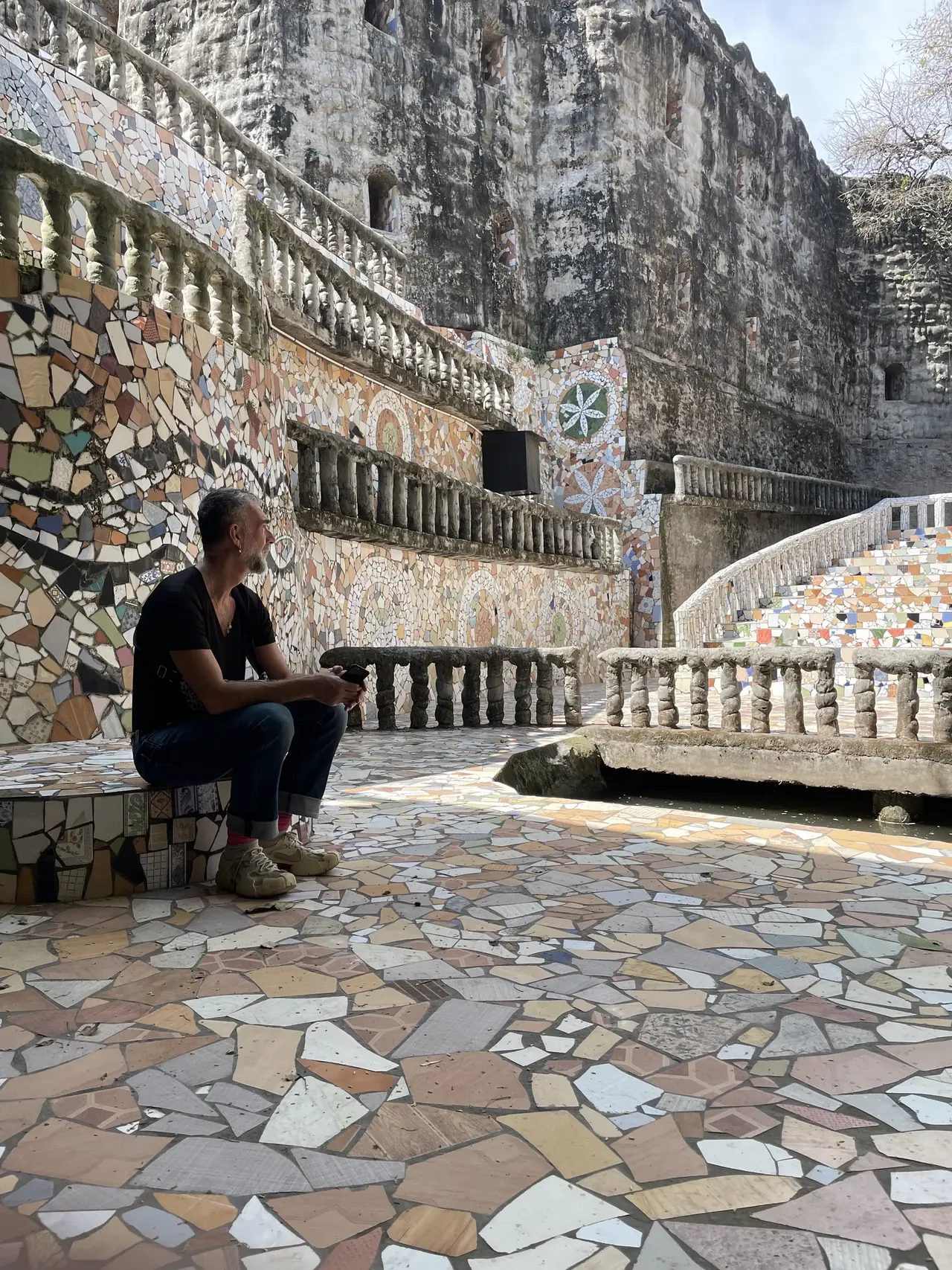
The Rock Garden was made by Nek Chand, a self-taught artist who worked as a government road inspector. He began building it in secret in the late 1950s, using broken crockery, tiles, bottles and waste from the villages cleared to build Chandigarh. He worked on it alone for nearly 18 years until officials discovered it in the mid-1970s. Instead of demolishing it, the city opened it to the public.
Chandigarh has sectors numbered from 1 to 63, built in phases from the 1950s onward. The first phase covered Sectors 1 to 30; later phases added the southern sectors. There is famously no Sector 13, because the number was considered unlucky. Sector 1 is the Capitol Complex, and Sector 17 is the city centre.
Le Corbusier designed Chandigarh as a grid of near-equal blocks called sectors, each about 800 by 1,200 metres, a size most sectors still keep. Each sector was meant to be self-contained, with its own market, places of worship, parks, schools and homes. Fast traffic runs on the roads around each sector, while the inside is designed for walking and cycling.
In the evening, Sukhna Lake is the city's favourite spot for a sunset walk. After dark, the Sector 17 plaza is lit up and lively, Sector 26 and the Madhya Marg have the city's bars and clubs, and Elante Mall stays busy late. The Capitol Complex and Rock Garden close in the evening, but a drive along the tree-lined avenues at night is worth doing.
The Rock Garden, the Natural History Museum, the International Dolls Museum, the Bird Park and Sukhna Lake are our top places to visit with children. They are safe, open and fun, and help children learn about Chandigarh's architecture, history and heritage.
The Rock Garden in Chandigarh is open every day from 9:30am to 6pm. Go early on a weekday, as soon as it opens, to avoid the crowds.
A Rock Garden ticket costs ₹30 for adults and ₹10 for children. Buy your ticket in person at the counter at the Rock Garden entrance.
Plan on one and a half to two hours for the Rock Garden. It spreads over about 40 acres of winding paths, courtyards, waterfalls and thousands of sculptures, and many people end up staying longer than they planned. Wear comfortable shoes, as there are steps and narrow passages.
The best time to visit the Rock Garden is early on a weekday morning, at 9:30am when it opens, before the crowds arrive. The Rock Garden is open seven days a week, from 9:30am to 6pm.
The best time to visit Sukhna Lake is at sunrise or sunset, when the light over the Shivalik hills is beautiful and the promenade is busy with walkers and joggers. From November to February, migratory birds gather on the lake. Avoid the middle of the day in summer, when there is little shade.
The Rose Garden is best visited in winter and spring, when the roses are in bloom and the sun is gentle. In summer it gets very hot, so avoid 12pm to 3pm; go around 10am or in the early evening, at 5 or 6pm.
The four museums worth your time are the Government Museum and Art Gallery (Sector 10), for Gandhara sculpture and miniature paintings in a Le Corbusier building; the Chandigarh Architecture Museum (Sector 10); the Le Corbusier Centre (Sector 19); and the Pierre Jeanneret Museum (Sector 5). All are open 10am to 5pm and closed on Mondays.
The Chandigarh Architecture Museum in Sector 10 tells the story of how the city was planned and built, with original drawings, sketches, letters, furniture and photographs. The building was designed by the Indian architect S.D. Sharma, who worked with Le Corbusier and Pierre Jeanneret, and opened in 1997. It is based on Le Corbusier's design for an exhibition pavilion in Zurich. It is a must for architects visiting Chandigarh.
Sector 17 is Chandigarh's city centre, a large pedestrian plaza designed by Le Corbusier as the heart of the city. It is famous for its shops, fountains, open squares, the old Neelam cinema and its long concrete arcades. People come here for shopping, dates, street performances and protests, and in the evening it is one of the liveliest places in town.
Spend day one on Le Corbusier's architecture: the Capitol Complex, the Le Corbusier Centre and the Government Museum. Make day two about Pierre Jeanneret: his house, Panjab University and the government housing he designed. Use day three for the art and heritage that came after them, such as the Rock Garden, Sukhna Lake and the Sector 17 plaza, or take a day trip to Kasauli or Pinjore.
Yes. Chandigarh sits between the two, so it is easy to combine. Shimla is about 115 km north (three and a half to four hours by road), good for mountain air and colonial history. Amritsar is about 230 km west (four to five hours), home to the Golden Temple and the Wagah border. With a week, you can do all three. See our Shimla tour, Amritsar tour and Raj to Republic circuit.
Spend two days in Chandigarh on its architecture, then drive or take the toy train up to Shimla. The Kalka–Shimla railway, a UNESCO World Heritage line, starts about 25 km from Chandigarh. Spend two days in Shimla on the Mall Road, Christ Church, the Viceregal Lodge and Jakhu Hill. Four days in total is ideal. Our Shimla tour covers the colonial history in depth.
Spend two days in Chandigarh, then travel to Amritsar by road (four to five hours) or train. Give Amritsar two days: the Golden Temple at dawn and again at night, Jallianwala Bagh, the Partition Museum, the Wagah border ceremony in the afternoon, and the old city's food trail. Our Amritsar Sikh history and food tour covers all of this.
December in Chandigarh is cool and mostly dry, with daytime highs of about 20 to 22°C and nights around 6 to 8°C. Afternoons are sunny and pleasant for sightseeing, but mornings are often foggy, which can delay flights and trains. Bring a warm jacket for early mornings and evenings.
September in Chandigarh is warm and humid, with highs of about 32 to 34°C. The monsoon usually ends during the month, so expect some rain in the first half and clearer, greener days towards the end. It is a decent time to visit, and the city looks its lushest after the rains.
The monsoon, July and August, is not the best time to visit Chandigarh. Heavy rain often floods roads, causes traffic jams and diversions, and makes outdoor sightseeing hard. If you do come then, the city is very green and quiet; plan indoor stops like museums and keep your days flexible.
Very hot. In May and June, daytime temperatures in Chandigarh are usually 38 to 42°C and can reach 44°C (112°F). If you visit in summer, plan your sightseeing for early morning and late afternoon, and spend the hottest hours in museums or cafes. On our summer tours we carry UV umbrellas and cold water and plan the route to avoid the midday sun.
From mid-December to January, nights in Chandigarh drop to about 4 to 7°C and daytime highs are around 18 to 20°C. Dense fog is common in the mornings and can delay flights and trains, sometimes by several hours. Afternoons are usually clear and sunny, which makes winter a lovely time for sightseeing if you start a little later.
Pack comfortable walking shoes, a hat and sunglasses, as most of Chandigarh's sights are outdoors. In summer, bring light cotton clothes and sunscreen; in winter (December and January), add a warm jacket and layers for foggy mornings. Carry your passport or photo ID for the Capitol Complex, and a refillable water bottle.
By air, Chandigarh airport (IXC) has direct flights from Delhi, Mumbai, Bengaluru and other major Indian cities. By train, Chandigarh Junction is about three hours from Delhi on the Vande Bharat or Shatabdi. By road, Chandigarh is about 250 km from Delhi on the NH44, with regular buses to the ISBTs in Sector 17 and Sector 43.
Uber is the easiest way to get around Chandigarh: reliable, safe, available 24 hours, and it accepts international cards. Auto-rickshaws are everywhere for short trips. Chandigarh has no metro, and the local buses are hard for visitors to figure out. To see the main sights in a day, a car with a driver or a guided tour with transport saves a lot of time.
Yes. Both Uber and Ola work across Chandigarh and the tricity (Mohali and Panchkula), including to and from the airport. Uber is usually the more reliable choice for visitors because it accepts international cards. You can book cars and auto-rickshaws in both apps.
Yes, within a sector. Each sector was designed for walking, with shaded footpaths, parks and dedicated cycle tracks. But the main sights are spread across the city, often several kilometres apart, so you will need a car or Uber to get between them. When the weather is good, a walk around Sector 17 or along Sukhna Lake is a pleasure.
Chandigarh is known for hearty Punjabi food: chole bhature, stuffed parathas, butter chicken, dal makhani, tandoori dishes and thick lassi. It also has a big cafe culture and some of North India's best fine dining.
Yes. Chandigarh is very easy for vegetarians. Punjabi cooking has many vegetarian classics, like chole bhature, paneer dishes, dal makhani, stuffed parathas and sarson ka saag, and almost every restaurant has a large vegetarian menu. Many eateries are fully vegetarian, and vegan options are easy to find in the city's cafes.
Most of Chandigarh's bars, pubs and clubs are in Sector 26 along the Madhya Marg, with more in Sectors 7, 8 and 9 and at Elante Mall. You can also order alcohol at most good hotels and many restaurants. Carry ID: the legal drinking age in Chandigarh is 25.
Chandigarh is built in the modernist style, and its most famous buildings are Brutalist: raw concrete, bold shapes and heavy sun-shading. Le Corbusier and Pierre Jeanneret adapted modernism to India's hot climate with brise-soleil (sun breakers), deep verandas, shaded courtyards and local brick. The result is one of the largest and purest collections of modernist architecture anywhere.
Béton brut is French for "raw concrete". It describes concrete left unpainted and unpolished after casting, so you can still see the marks of the wooden formwork on the surface. Le Corbusier made it famous, and it gave the Brutalist style its name. You can see béton brut everywhere in Chandigarh's Capitol Complex.
A brise-soleil (French for "sun breaker") is a screen of fins or deep concrete frames on the outside of a building that blocks direct sun while letting in light and air. Le Corbusier used them all over Chandigarh, most clearly on the Secretariat, the High Court and the Tower of Shadows, to keep buildings cool without air conditioning.
Chandigarh is called "the City Beautiful" because of its planned layout, wide tree-lined avenues, green belts, gardens and clean, orderly streets. The nickname appears on the city's road signs and official branding. Many visitors say it feels unlike any other Indian city.
Chandigarh is clean because it was planned that way. Wide roads, defined markets, green belts and separate zones for homes and industry keep the city orderly. A well-funded city administration, strict building rules and a well-off, civic-minded population help too. Chandigarh regularly ranks among India's cleanest cities in national surveys.
Neither. Chandigarh is a union territory run by India's central government. It is also the capital of both Punjab and Haryana, and sits on the border between the two states. Mohali, next door, is in Punjab, and Panchkula is in Haryana.
When Punjab was split into Punjab and Haryana in 1966, both states claimed Chandigarh as their capital. As a compromise, the central government made the city a union territory, which it runs directly, and let it serve as the capital of both states. That arrangement is still in place today.
Chandigarh was built as the capital of Punjab. In 1966 Punjab was divided to create Haryana, and both states wanted to keep the city. The dispute was never settled, so Chandigarh became a union territory and serves as the capital of both Punjab and Haryana. Both state governments work from the same Secretariat and Palace of Assembly in the Capitol Complex.
Chandigarh is famous for being India's first planned city, designed by Le Corbusier, and for its Capitol Complex, a UNESCO World Heritage Site. It is also known for the Rock Garden, Sukhna Lake, its green, orderly sectors and its peace and quiet. Many visitors say it feels almost European compared with the rest of India.
The "tricity" is Chandigarh together with its two neighbouring cities: Mohali (in Punjab) to the west and Panchkula (in Haryana) to the east. They have grown into one continuous urban area, so locals treat them as one city, even though each is run by a different government.
All three are 20th-century planned capitals, but they differ. Canberra (planned in 1913 by Walter and Marion Griffin) is a garden city built around a lake. Brasília (1960, by Lúcio Costa and Oscar Niemeyer) is shaped like an aeroplane and built for cars. Chandigarh (1950s, Le Corbusier) is a grid of walkable, self-contained sectors, with government at the "head". It is also the only one of the three where everyday housing and furniture were designed by the same team.
Yes. A hop-on hop-off double-decker bus runs every day, stopping at Hotel Shivalik View, the Rose Garden, the Government Museum, the War Memorial, the Bougainvillea Garden, the Capitol Complex, the Rock Garden and Sukhna Lake. It is a cheap way to see the main sights from the road, but there is no guide to explain what you are looking at, and it does not take you inside the buildings. For the stories behind Le Corbusier's city and access to places the bus skips, book a private Chandigarh tour with Rusty.
The hop-on hop-off bus departs from Hotel Shivalik View in Sector 17. In summer the departures are at 9am, 10:30am, 3:30pm and 5pm; in winter at 9am, 10:30am, 12pm, 2pm and 3:30pm.
Yes. Hipster India Tours runs in-depth heritage tours through Chandigarh's modernist buildings, including Pierre Jeanneret's government housing in the sectors where Rusty grew up, the Panjab University campus and the Sector 17 plaza. For a guided architecture walk any day of the week, book with us.
The best day trips from Chandigarh are Kasauli (about 60 km, a quiet colonial hill town), the Pinjore Gardens (about 20 km, Mughal-style terraced gardens), the Morni Hills (about 45 km, lakes and forest walks), the Kalka–Shimla toy train, and Anandpur Sahib (about 90 km, a major Sikh pilgrimage town). Shimla itself is possible in a long day, but it is better with an overnight stay.
Yes. Kasauli is about 60 km from Chandigarh, about one and a half to two hours by road, so it makes an easy day trip. Leave early, walk the Mall Road and Christ Church, and catch the sunset at Sunset Point before driving back. Avoid weekends if you can, when traffic on the hill road gets heavy.
Architecture students should see the Capitol Complex (Palace of Assembly, High Court, Secretariat, Tower of Shadows and Open Hand), Pierre Jeanneret's Gandhi Bhawan and AC Joshi Library at Panjab University, the Le Corbusier Centre and the Architecture Museum, the Government Museum and Art Gallery, the Sector 17 plaza and the government housing in the older sectors. We run study tours for architecture colleges with insider access to many of these buildings. Contact us to plan one.
They are very different. Delhi has centuries of history, great monuments and museums, and much better street food and nightlife, but it is crowded and loud. Chandigarh is quiet, green, orderly and walkable, with the world's largest collection of Le Corbusier's architecture. If you love architecture or need a break from the chaos, add Chandigarh to your Delhi trip; it's only three hours away by train.
Choose Jaipur for palaces, forts, bazaars and classic royal Rajasthan. Choose Chandigarh for modern architecture, calm streets and a very different, contemporary side of India. Both are good short trips from Delhi. Jaipur is busier and more touristy; Chandigarh is quieter and better if you are interested in design, urban planning or Le Corbusier.
It depends on what you want. Shimla is a hill station, with cool mountain air, colonial buildings and views, best in summer when the plains are hot. Chandigarh is a modern planned city with world-class architecture, best from October to March. They are only three to four hours apart, so many visitors do both: Chandigarh first, then up to Shimla.
Yes. Almost all of Chandigarh's main sights are wheelchair accessible, helped by the city's wide, flat roads, ramps and open plazas. That includes the Capitol Complex, Sukhna Lake and the museums. A few spots have steps or narrow passages, such as parts of the Rock Garden. Tell us about your needs when you book, and we will plan the route and transport around them.
Most foreign visitors need an Indian visa to visit Chandigarh, just as for anywhere else in India. Many nationalities can apply online for an Indian e-Visa on the official site (indianvisaonline.gov.in) at least four days before travel. There is no separate permit for Chandigarh, but carry your passport, as you need it to register for the Capitol Complex tour.
Jio and Airtel have the best coverage in Chandigarh. You can buy a tourist SIM at Delhi airport or a phone shop with your passport and visa; setup can take a few hours. An international eSIM bought before you fly is often easier for short trips. Either way, you will want data for Uber, maps and UPI payments.
Most hotels, restaurants, malls and Uber accept international cards. Almost everyone else, from cafes to small shops, uses UPI (India's phone payment system). Foreign visitors can use UPI through the UPI One World wallet available at some airports. Still, carry some cash in small notes for auto-rickshaws, street food, tips and entry tickets.
Tipping is not compulsory in India, but it is appreciated. In restaurants, 5 to 10 percent is normal if a service charge has not been added. For drivers, guides and hotel staff, a tip that reflects good service is welcome. On Hipster India Tours, tips are optional and never included in the price.
Chandigarh's airport, Shaheed Bhagat Singh International Airport, is in Mohali, about 12 to 15 km from the city centre. Uber and prepaid taxis are the easiest way into town, taking 25 to 40 minutes depending on traffic. If you are touring with Hipster India Tours, Rusty can pick you up from the airport on request.
The usual explanation is that many smaller Indian airports were given three-letter codes starting with "IX" (such as IXB Bagdogra, IXJ Jammu and IXL Leh) when the obvious codes were already taken by airports elsewhere in the world. The "C" stands for Chandigarh. So IXC simply means "Indian airport, Chandigarh".
Sector 17 is Chandigarh's main shopping area, with brand stores, bookshops and the open-air plaza. Sector 22's Shastri Market is good for budget clothes and bargains, and Elante Mall in the Industrial Area has international brands. For crafts, look for phulkari embroidery and Punjabi juttis (shoes) in the Sector 17 and Sector 22 markets.
Good things to buy in Chandigarh are phulkari embroidered dupattas and shawls, handmade Punjabi juttis, and books and prints on Le Corbusier from the Le Corbusier Centre. If you love design, have a replica Pierre Jeanneret chair made by local craftspeople. Never buy an "original", as these are government property and cannot legally leave the city.